
What you’ll get from this guide
- Most cleaning businesses undercharge by 20–40% by copying competitor rates instead of calculating true operational costs.
- Average maid service rates run $40–$80/hour per cleaner internally, but should be sold as flat rates to protect margins.
- Deep cleans cost 30–60% more than standard maintenance cleans because of heavier initial labor requirements.
- A 2,000 sq ft home averages $180–$280 for standard maintenance cleaning and $280–$400 for a deep clean.
- Use the house cleaning price calculator to estimate any residential job instantly.
Most Cleaning Businesses Undercharge by 20–40%
Many cleaning company owners copy local competitors, guess pricing from Facebook groups, or charge hourly without understanding their actual margins. In 2026, profitable cleaning companies price differently. They prioritize route density, recurring client retention, and operational efficiency over simple hourly wages.
This guide breaks down the real pricing benchmarks, how to calculate profitable pricing structures, and how modern cleaning businesses avoid underpricing while building high-margin recurring revenue.
- Recurring cleans priced separately from deep cleans
- Why route density and LTV shift profitability
- Real pricing benchmarks (bedrooms, square footage, add-ons)
- Why hourly pricing kills margins
Average House Cleaning Prices at a Glance
| Pricing Method | Average Rate | Best For |
|---|---|---|
| Hourly Rate | $40 – $80 / hour / cleaner | Deep cleans, clutter, first-time visits |
| Flat Rate (Per Home) | $150 – $300 (3 Bed / 2 Bath) | Recurring maintenance cleans |
| Per Square Foot | $0.08 – $0.15 / sq ft | Large homes, commercial-adjacent work |
| Move-out Clean | $250 – $450 (3 Bed) | Empty homes and move-out projects |
House Cleaning Prices by Bedroom Count
| Home Size | Standard Clean | Deep Clean | Recurring Discount |
|---|---|---|---|
| Studio / 1 bed | $80 – $120 | $130 – $180 | 10–15% off |
| 2 bed / 1 bath | $120 – $160 | $180 – $240 | 10–15% off |
| 3 bed / 2 bath | $150 – $220 | $220 – $320 | 10–15% off |
| 4 bed / 2+ bath | $200 – $280 | $280 – $400 | 10–15% off |
| 5 bed / 3+ bath | $280 – $380 | $380 – $500+ | 10–15% off |
| Apartment (1–2 bed) | $90 – $140 | $140 – $200 | 10–15% less |
| Two-story house (3–4 bed) | $180 – $280 | $260 – $400 | 10–15% less |
Ranges vary by condition, region, and whether laundry, dishes, or inside-fridge style tasks are included.
House Cleaning Prices by Square Footage
| Home Size (sq ft) | Standard Clean | Deep Clean |
|---|---|---|
| Under 1,000 sq ft | $100 – $150 | $180 – $250 |
| 1,000 – 1,500 sq ft | $130 – $190 | $200 – $290 |
| 1,500 – 2,000 sq ft | $160 – $240 | $250 – $350 |
| 2,000 – 2,500 sq ft | $200 – $300 | $300 – $420 |
| 2,500 – 3,500 sq ft | $250 – $380 | $380 – $520 |
| 3,500 – 5,000 sq ft | $350 – $500 | $500 – $700+ |
Pricing per square foot works best for larger homes. Most cleaners still use bedroom count for standard quoting because customers think in bedrooms, not square footage.
Why Hourly Pricing Kills Your Margins (And What to Do Instead)
Hourly pricing penalizes efficiency. The faster and more professional your crews get, the less you earn per job. More importantly, homeowners hate open-ended bills and prefer knowing the exact price upfront.
Flat-rate pricing is what customers want, but you bear the risk. If you underquote a flat-rate job, your hourly yield drops. To protect your margin, calculate your floor rate internally (labor + travel + overhead + profit margin) and present it as a firm, non-negotiable flat rate to the client.
Profitable residential cleaning businesses use hourly math to estimate the workload, but quote flat rates to capture the upside of their team's speed.
How Much to Charge per Hour for House Cleaning
| Setup | Hourly rate (whole crew) | Typical house | When to use it |
|---|---|---|---|
| One cleaner (solo) | $40 – $60 / hour | 2-bed: 2–3 hours | New clients and homes you have not seen |
| Team of 2 | $70 – $110 / hour | 3-bed: 1.5–2 hours | Recurring routes, where speed protects margin |
| Team of 3 | $100 – $160 / hour | 4-bed: 1.5–2 hours | Large homes and first cleans |
| Per-visit minimum | $100 – $150 | Any size | Covers drive time and setup on small jobs |
These rates are what you bill per elapsed hour for the whole crew, not per cleaner — the team-of-2 row is the total for both people on site. Work out your cost floor from what you pay each cleaner, then quote the client a flat price.
Example Profit Breakdown: 3-Bed Recurring Clean
| Metric / Cost Item | Amount | Percentage of Revenue |
|---|---|---|
| Job Revenue | $180 | 100% |
| Labor Costs (2 hours @ $35/hr) | $70 | 39% |
| Supplies & Travel | $18 | 10% |
| Gross Margin | $92 | 51% |
A 50%+ gross margin is the target benchmark for highly profitable residential cleaning companies in 2026.
The Hybrid Strategy
Charge hourly for the first clean to establish a baseline. Then, offer a flat rate for recurring visits once you know the home.
This protects you against the unknown on the first visit while still letting you move customers into the cleaner, more sellable flat-rate model.
Why Recurring Cleaning Clients Are More Profitable
Most highly profitable cleaning companies intentionally prioritize weekly, biweekly, or subscription-style recurring clients, even if it means offering a discount of 10–15% off the first clean.
Recurring cleaning clients are the backbone of a predictable business. The homes stay easier to clean, teams move faster on subsequent visits, schedules stabilize, and customer acquisition costs are amortized over a much longer lifetime value (LTV).
Additionally, recurring billing simplifies your collections, stabilizing cash flow and increasing the equity value of your business.
- Weekly / biweekly cleans: lowest labor time per visit, predictable schedule density
- Monthly cleans: requires slightly more detail, but maintains recurring predictability
- One-time cleans: highest customer acquisition cost, unpredictable labor variance
Recurring Revenue Predictability Analysis
| Client Type | Revenue Pattern | LTV & Churn Risk |
|---|---|---|
| One-time deep cleans | Unpredictable & spiky | High churn, low lifetime value (LTV) |
| Weekly recurring | Stable & highly predictable | Low churn, maximum lifetime value |
| Biweekly recurring | Best balance of volume & frequency | Low churn, high lifetime value |
| Monthly only | Marginal predictability | Moderate churn risk |
First Clean vs. Recurring Clean Pricing
First cleans should almost always cost more than recurring visits.
The first visit usually includes extra reset work: built-up dust, soap scum, kitchen grease, clutter friction, and slower pacing because the team has never seen the home before.
Recurring visits are cheaper because the home is already at maintenance level. That is why many cleaners price recurring visits 10–15% lower than the first visit once the baseline is established.
- First clean: highest labor risk, highest price — typically 20–30% above recurring rate
- Weekly / biweekly recurring clean: lower labor time, lower price
- Monthly clean: often between maintenance and deep-clean pricing depending on condition
Deep Clean vs. Maintenance Clean
A standard maintenance clean and a deep clean should not carry the same price.
Maintenance cleaning assumes the home is already in decent ongoing condition. Deep cleaning usually includes heavier bathroom buildup, kitchen degreasing, baseboards, hand-detailing, and slower work in neglected rooms.
If you price both the same way, your deep cleans will crush your hourly earnings.
- Standard clean: regular dusting, vacuuming, mopping, kitchen and bath reset
- Deep clean: detailed bathroom and kitchen work, buildup removal, edges, trim, and neglected surfaces — typically 30–60% more
- Move-out clean: often priced separately because it behaves more like an empty-home project than a routine clean
Got your price?
LeadDuo Invoice turns it into a quote or invoice in minutes. ServiceHub automates the bookings, reminders, and follow-ups around it.
Post-Construction Cleaning: What to Charge
Post-construction is not a deep clean with extra steps. Two ways to price it, and they deliberately bracket each other: 2–3× your standard rate, or $0.30 – $0.50 per square foot. For a 2,000 sq ft home you clean for $200 on maintenance, the multiplier gives $400 – $600 and the square-foot method gives $600 – $1,000. Quote toward the top of that spread when the dust is fresh and trades are still on site, and toward the bottom for a final touch-up after handover.
The reason is fine dust. Drywall and sanding dust settles back out of the air for hours, so surfaces have to be wiped more than once and filters clog fast. Budget a second pass into the quote rather than discovering it on site.
Charge separately for sticker and adhesive removal from windows and appliances, paint and grout haze, and debris haul-away. These are the line items that quietly eat a post-construction job.
Quote in phases when the builder will let you: rough clean after framing, final clean after fixtures, and a touch-up before handover. Three smaller invoices beat one price you have to defend.
Common Add-On Pricing
| Add-On | Typical Price | Notes |
|---|---|---|
| Inside oven | $25 – $50 | Higher for heavy grease or neglected buildup |
| Inside fridge | $20 – $40 | Often paired with move-out or deep-clean work |
| Inside windows | $5 – $10 per window | Depends on glass access and condition |
| Laundry / folding | $15 – $40 | Best treated as a separate line item |
| Bed linen change | $10 – $20 per bed | Common for recurring premium clients |
| Dishes | $10 – $25 | Should not be silently included in base pricing |
| Garage sweep / organize | $30 – $60 | Depends on size and clutter level |
| Baseboards (detailed) | $20 – $40 | Often included in deep clean, extra for standard |
Keep add-ons visible in the quote. That protects your base price and makes the upsell easier to explain.
Price by Room and by Task
| Room or task | Standard clean | Deep clean | Notes |
|---|---|---|---|
| Full bathroom | $25 – $45 | $45 – $75 | Showers, hard water and grout take the most time |
| Half bathroom | $15 – $25 | $25 – $40 | Quick if it is only a toilet and sink |
| Kitchen | $35 – $60 | $60 – $110 | Excludes inside-oven and inside-fridge |
| Bedroom | $20 – $35 | $35 – $55 | Add for under-bed and inside-closet work |
| Living or dining room | $20 – $35 | $35 – $60 | Add for baseboards and blinds |
Room-by-room pricing adds up to more than a whole-house rate, and that is correct — you lose the efficiency of cleaning the house in one pass. Quote à la carte only for partial jobs.
Why House Cleaning Prices Vary by City
| City / Metro | Standard Clean (3 Bed) | Deep Clean (3 Bed) | Avg Hourly Rate |
|---|---|---|---|
| New York City | $220 – $300 | $320 – $450 | $55 – $85/hr |
| Los Angeles | $200 – $280 | $300 – $420 | $50 – $80/hr |
| Chicago | $160 – $220 | $240 – $340 | $45 – $70/hr |
| Miami | $180 – $250 | $270 – $380 | $45 – $75/hr |
| Austin / Dallas | $140 – $200 | $220 – $310 | $40 – $65/hr |
| Phoenix | $130 – $180 | $200 – $280 | $38 – $60/hr |
| Midwest / South (smaller metros) | $120 – $170 | $180 – $260 | $35 – $55/hr |
Major cities and coastal metros support higher pricing because wages, travel time, parking, and client expectations are higher. Use national ranges as a starting point, then adjust for your local labor market.
How to Raise Your Prices Without Losing Clients
Inflation happens. Your costs go up. You need to raise prices eventually.
The mistake is waiting until your margin is already gone, then apologizing for the increase. Price changes land better when they are framed as a normal part of keeping service quality stable.
When it is time to send the notice, use the cleaning price increase letter template instead of improvising the email, SMS, or contract language from scratch.
- Give notice: Tell them 30 days in advance.
- Explain why: "To continue providing the high-quality supplies and reliable staff you love..."
- Be confident: Don't apologize for running a profitable business.
What Happens After You Send the Quote Matters More Than the Quote Itself
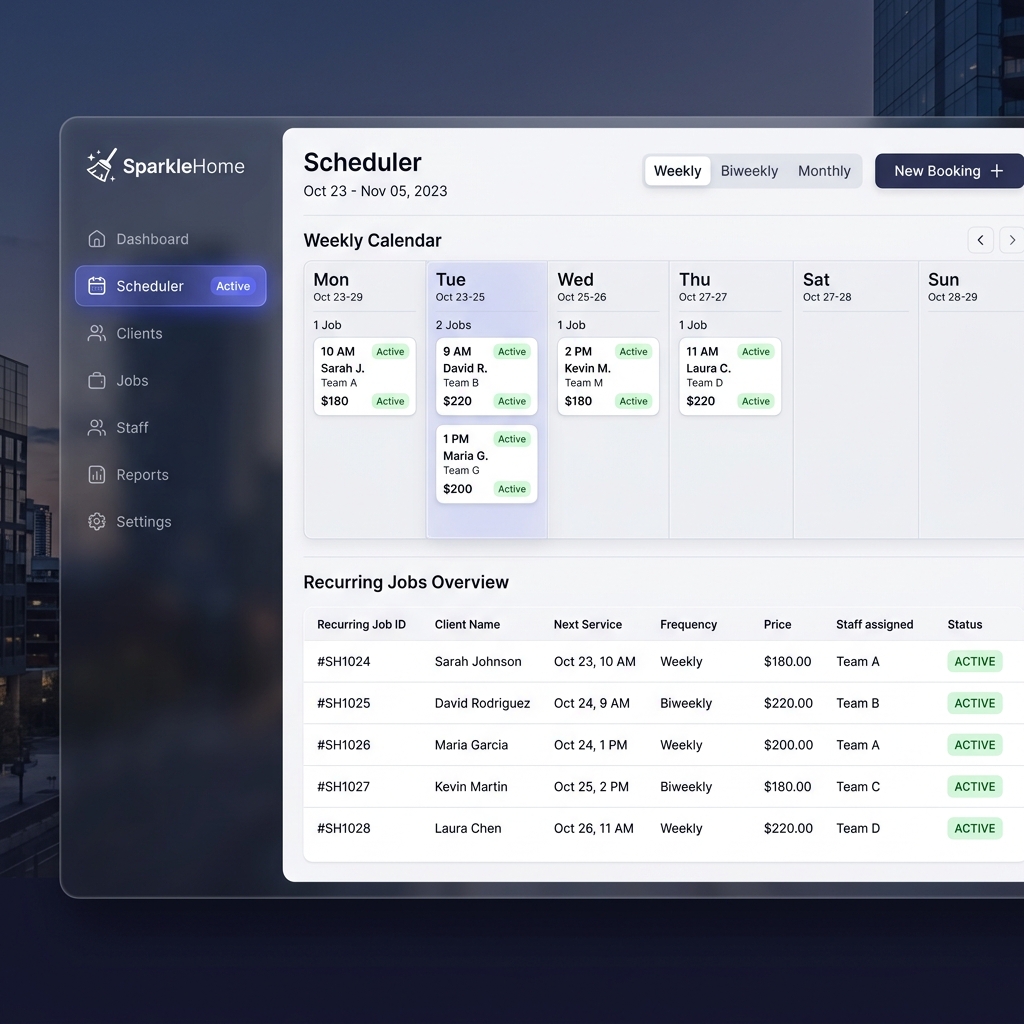
Many cleaning quotes die not because the price is wrong, but because the business fails to follow up. Stale estimates, missed appointment confirmations, and slow billing response rates leak revenue daily.
Automating client communication ensures quotes are followed up, recurring schedules are locked in, and unpaid invoices are recovered without manual admin overhead.
Build Accurate Quotes Every Time
The biggest mistake is guessing a price over the phone. You will almost always underbid.
Use a standardized pricing engine or calculator that starts from bedrooms, baths, add-ons, and your actual labor target instead of pure instinct.
Related Cleaning Business Resources
Build your pricing foundation with these guides and tools:
House Cleaning Prices by State (2026) — what to charge in each US market.
- What to Charge for House Cleaning (2026) — calculator + quote scripts for residential jobs
- Cleaning Estimate Template — professional estimate you can send in minutes
- Cleaning Service Agreement Template — protect yourself with a proper contract
- Cleaning Proposal Template (2026) — win commercial and residential bids
- Best Cleaning Business Software (2026) — compare scheduling and invoicing tools
- Cleaning Scheduling Software Comparison — side-by-side feature breakdown
- How to Raise Cleaning Prices — scripts and timing for price increases
- How Much to Charge for Air Duct Cleaning (2026) — a higher-margin add-on service, with a duct cleaning price calculator
How to Build a Cleaning Estimate, Step by Step
1. Ask before you look. Square footage, bedrooms and bathrooms, pets, how long since the last clean, and whether this is a one-off or recurring. Those five answers decide most of the price.
2. Walk it, or ask for photos. Kitchens and bathrooms carry the hours. Condition matters more than size — a neglected 2-bed beats a maintained 4-bed for time every time.
3. Estimate hours, then apply the crew rate. Multiply the expected on-site hours by the rate for your crew size in the table above. That table is already a whole-crew rate, so do not multiply by headcount again. The result is your cost floor, not your price.
4. Add the extras as visible line items. Inside-oven, inside-fridge, windows, laundry. Keeping them separate protects the base price and makes the upsell easy to explain.
5. Present one flat number. Clients buy a price, not a formula. Quote the flat figure, keep the hourly math in your own notes, and put a re-quote clause in for conditions that were not visible.
The house cleaning price calculator does step 4 for you — it builds a flat starting price from bedrooms, bathrooms, cleaning type, frequency and add-ons. Step 3 stays yours: check that number against your own hours and crew rate before you send it.
Frequently Asked Questions
How much should I pay someone to clean my house?▼
How much does it cost to clean a 2,000 sq ft house?▼
How much does a maid cost per hour in 2026?▼
Should house cleaning be priced hourly or flat rate?▼
How much more should a deep clean cost?▼
What should I charge for add-ons like oven or fridge cleaning?▼
Should recurring clients get a discount?▼
How much does a move-out clean cost?▼
Do house cleaning prices vary by city or region?▼
How do I raise my cleaning prices without losing clients?▼
How much does house cleaning cost per hour?▼
How much should I charge to clean a bathroom?▼
How much to charge to clean a two-story house?▼
How much should I charge for post-construction cleaning?▼
How much does house cleaning cost in the United States?▼
How much does an independent house cleaner charge?▼
How much do house cleaners get paid per house?▼
Build Your Own Cleaning Price List — Free
Use our Cleaning Price List Builder to create a professional price list — free to build, pre-filled with standard cleaning, deep cleaning, move-out, and add-on services. Export as PDF or CSV with a Price Book Pass.
Join 500+ contractors and service pros
What happens after you send the quote matters more than the quote itself
LeadDuo helps cleaning businesses automate recurring quotes, recover stale estimates, manage recurring billing, detect missed follow-ups, and send payment reminders automatically.
Join 500+ contractors and service pros